
I’ll never forget the time when an educated family member of a humble family quietly uttered the word “palliative” to me. It sounded like it was something to be embarrassed about, akin to admitting the diagnosis of HIV in the older-years. They were loving, attentive people, who were wholeheartedly dedicated to their caring for their mother’s well-being. But they equated palliative care with surrender.
That moment, amongst many others in the palliative wards, has stayed with me.
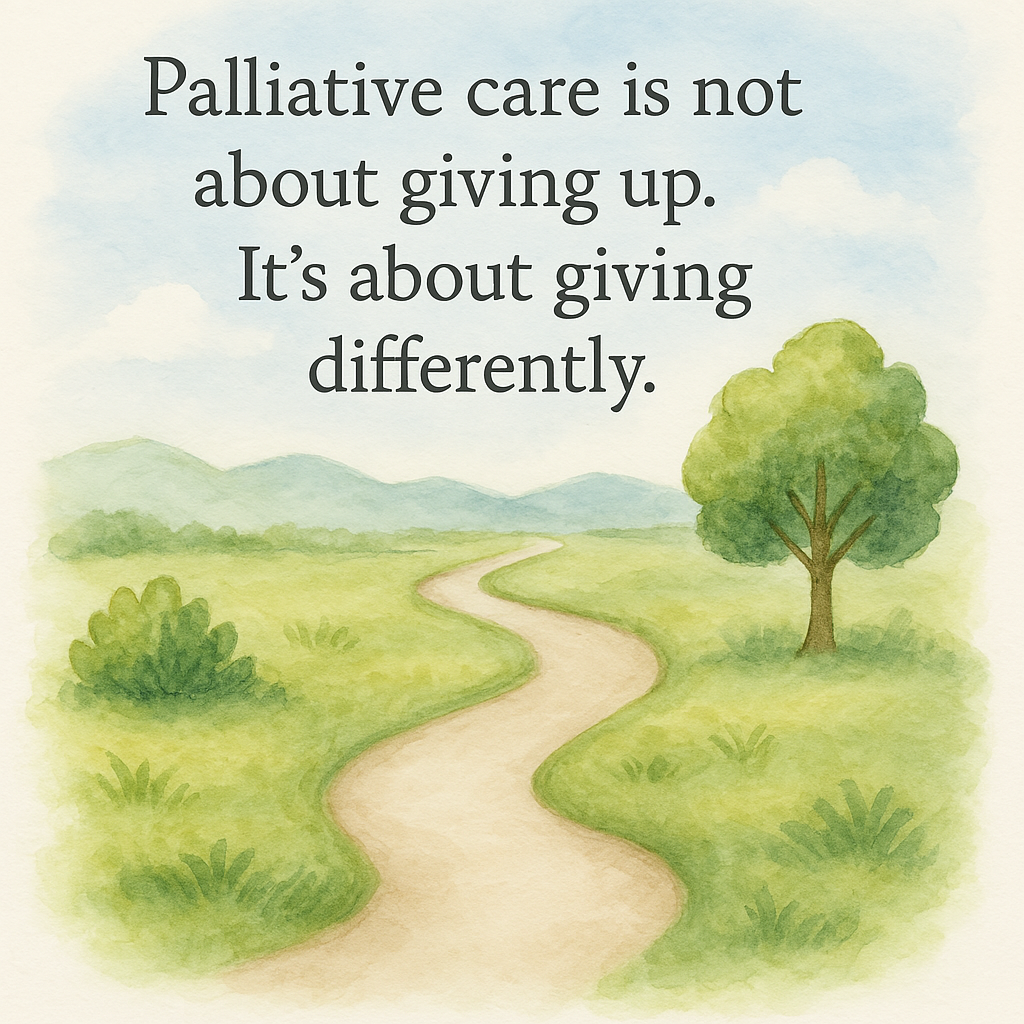
Because with each patient who receives palliative care, the realization grows stronger, that palliation isn’t about giving up. It’s about giving differently.
With dignity. With relief. With purpose.
And here in India, slowly but steadily, most of us are beginning to realize that.
Where We Started
For years, palliative care in India remained in the background. It was considered a last-ditch effort or, worse, was completely overlooked.
The medical focus mainly remained on curing diseases. Conversations about death were rare, and patients were often kept in the dark about their diagnoses. Comfort was a privilege of the elite, often left to families, Families, who tried their best to provide it all to the patient at their homes, often over-treating to no avail, almost always without any guidance, if not with misinformation.
But pain, distress, and emotional suffering don’t wait for cures. Many patients endure in silence, even when medicine has little left to offer. It deeply saddens me to admit that this is still rampant in a large part of India.
What’s Shifting Now
Things are slowly beginning to change though.
Palliative care has now made its way into hospitals, cancer institutes, and is entering community clinics too in a few places. There’s a growing understanding and acceptance of the fact that healthcare should go beyond just fighting illness, it should support life in all its fragility, in all its stages.
This shift is showing up via:
- Earlier involvement: More doctors are referring patients to palliative care earlier, not just at the very end.
- Comprehensive teams: Care now involves not just physicians and nurses, but also counselors, social workers, and spiritual guides.
- Outreach programs: Home-based care, palliative nurses, and local volunteers are bringing relief outside of the corporate and urbane settings.
- Education and awareness: Medical students and young doctors are being trained in palliative care.
Still a Long Road Ahead
Even with progress, most Indians, especially in rural areas, still don’t have access to palliative care.
Pain management remains inadequate. Opioids like morphine are hard to get, thanks to regulations and myths. Families often feel isolated and helpless as they navigate terminal illness. And fear of death still silences critical conversations.
We still hear:
“Are you saying there’s no hope?”
“Does this mean we stop all treatment?”
“If we talk about dying, won’t they lose the will to fight?”
These aren’t naïve questions. They’re deeply human! They are queries and dilemmas rooted in love, fear, and the urge to protect.
Palliative Care Isn’t a Pause, it’s a Path
It doesn’t mean you’re giving up on your loved one.
It means you’re holding onto their comfort. Their voice. Their dignity.
It’s about easing pain and breathlessness. Supporting emotional burdens. Facing uncertainty. Honouring what truly matters, even without a cure.
And it’s about caring for you, the caregiver, too.
What India Needs Next
To take palliative care where it’s needed most, we need:
- Policies that guarantee access to essential pain relief
- Public education to break the stigma and myths
- Palliative training in all medical and nursing programs
- Awareness campaigns and volunteer training drives
- Partnerships between government, private hospitals, and NGOs
- And above all, empathy. In clinics, in homes, and in policymaking
Be A Part of the Change
If you’re looking after someone with a serious illness, ask about palliative care early, not waiting for it to be offered at the end.
If you’re a doctor or nurse, I urge you to see palliative care not just as a specialty, but as a paradigm shift in perspective. One that brings more compassion, more humanity, into every kind of care.
Because no individual is just their diagnosis.
And every life, especially toward its end, deserves to be lived with comfort and meaning.

Leave a comment